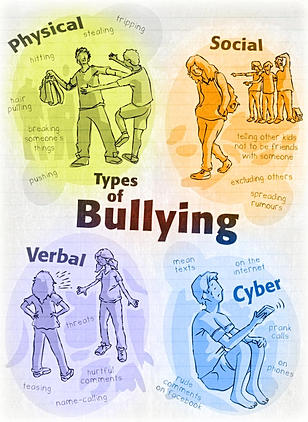
Ang pambubully ay hindi lng pisikal na pananakit ang sangkot dito maaaring kasali ang mga ito,Pagsasalita ng masakit,
Iniiwasang makasama,at Cyber bullying.Lahat ng bully ay nararanasan sa eskwela.Upang masugpo ang Bullying ay huwag
nalang silang pansinin.Kapag kayo ay binubully huwag nalang mag re-act.
Kaya kapag ang sinabi nila ay masakit na ay magsumbong nalang sa guro o kahit anong nakabubuti sa iyo.O kaya
ipa-alam o isumbong sa inyong magulang.kapag binully ka okaya tinanong ka ng nambubully sumagot sa paraan na
di inaasahan ng mambubully.Upang makaiwas sa pang-aasar huwag nalang silang patulan.
Upang maiwasan ang Bullying
Una,huwag mag re-act- Huwag gumanti upang hindi ka niya uliting bullyhin.Huwag lumapit sa mga mambubully upang
hindi ka bullyhin.Magsumbong sa magulang o guro.At sa lahat magkaroon ng kumpiyansa sa sarili dahil kapag na
pansin ka niya na nerbiyosa hindi ka niya bubullyhin.Magkaroon ng positibong pananaw sa sarili.Magpakita ng respeto
sa iyong mga kasamahan.Matutong ngumiti at bumati.Huwag pumayag na maliitin ka.Maging responsable.Matutong lumaban
Paano nga ba ito maiiwasan
Labanan mo ito sa pag-aaral ng mabuti.Mag-iba ka ng target na magiging kaibigan.One Time Big Time ipakilala
mo sa sarili mo kapag inaway ka.Huwag-na-huwag mong papansinin.At higit sa lahat kapag binully ka isumbong mo sa
magulang mo o guro mo.Umiwas nalang sa mga mambubully upang hindi ka ma bully nila at para hindi ka masaktan
kapag binully ka niya.
BULLYING
Ang bullying ay pisikal o emosyonal na pananakit. Gustong ipakita ng nananakit na higit siyang malakas kaysa isa.
At ang bullying ay nangyayari tuwi-tuwina.
Mayroong higit isang uri ng pananakit o bullying:
Pisikal na pananakit tulad ng panunulak, panununtok, pangunguwelyo
Pananakit sapamamagitan ng mga salita tulad ng panunukso o pagmumura
Pangkatang pananakit o social bullying tulad ng pagpapalaganap ng tsismis laban sa isang tao o pag-iwas sa tao
makasama sa isang pangkat
Pananakit sapamamagitan ng internet tulad ng pag-post sa facebook ng masasakit na salita o pagpapakita ng mga hindi
magagandang larawan para lang magpahiya.
Huwebes, Hunyo 25, 2015
What Is an Adjective?
The simplest definition of an adjective is that it is a word that describes or clarifies a noun. Adjectives describe nouns by giving some information about an object’s size, shape, age, color, origin or material.
It’s a big table. (size)
It’s a round table. (shape)
It’s an old table. (age)
It’s a brown table. (color)
It’s an English table. (origin)
It’s a wooden table. (material)
It’s a lovely table. (opinion)
It’s a broken table. (observation)
It’s a coffee table. (purpose)
When an item is defined by its purpose, that word is usually not an adjective, but it acts as one in that situation.
coffee table
pool hall
hunting cabin
baseball player
What Do Adjectives Look Like?
English can be very tricky, so you have to be careful, but a lot of English adjectives end with these suffixes:
Many adjectives also end with -y, -ary and -ate, but lots of nouns and adverbs also end with -y, lots of nouns also end with -ary, and lots of nouns and verbs also end with -ate, so be careful with those.
Where Do Adjectives Go in a Sentence?
If you come across a word that ends in -y, -ary or -ate (or any other suffix for that matter), and you want to know whether it’s an adjective or not, just look at where it is and what it’s doing in the sentence. If it comes immediately before a noun, and especially if it comes between an article (a, an, the), a possessive adjective (my, his, her, its, your, our, their), a demonstrative (this, that, these, those) or an amount (some, most, all, a few) and a noun, then it’s probably an adjective.
The grassy field was wet with dew. – “Grassy” comes between an article (the) and a noun (field), so you know it’s an adjective.
These are my old trophies. – “Old” comes between a possessive adjective (my) and a noun (trophies), making it an adjective.
We had a few ordinary days. – “Ordinary” comes between an amount (a few) and a noun (days), so it’s definitely an adjective.
Did you see that immaculate kitchen? – “Immaculate” comes between a demonstrative (that) and a noun (kitchen), so it must be an adjective.
Adjectives also act as complements. Complements are words that complete the predicate of a sentence when the verb is “be.”
He is tall.
We’ve been teachers for five years.
You were my best friend.
He was smart, handsome and rich.
As you can see, not all complements are adjectives. In these examples, “tall” and “smart, handsome and rich” are adjectives, but “teachers for five years” and “my best friend” are both noun phrases. If the complement is only one word, there’s a good chance it’s an adjective. Also if the complement is a list of words, those are probably also adjectives. If an article (a, an, the) or a possessive (my, his, her, its, your, our, their, mine, his, hers, its, yours, ours, theirs) is involved, it’s a noun phrase.
What’s the Correct Order for Multiple Adjectives?
When you list several adjectives in a row, there’s a specific order they need to be written or spoken. Native speakers of English tend to put them in the correct order naturally, but if you’re learning English, you’ll have to memorize the order. It goes like this:
Determiner – This means an article (a, an, the), a number or amount, a possessive adjective (my, his, her, its, your, our, their), or a demonstrative (this, that, these, those).
This is the correct order for adjectives that come directly before a noun, and they are separated by commas.
My beautiful, big, circular, antique, brown, English, wooden coffee table was broken in the move.
If the adjectives come after the verb “be” as the complement, then the qualifier will stick with the noun at the beginning of the sentence. The adjectives in the complement are separated by commas with the final two being separated by “and.” For example, My coffee table is beautiful, big, circular, antique, brown, English and wooden.
What Is an Adjective?
The simplest definition of an adjective is that it is a word that describes or clarifies a noun. Adjectives describe nouns by giving some information about an object’s size, shape, age, color, origin or material.
It’s a big table. (size)
It’s a round table. (shape)
It’s an old table. (age)
It’s a brown table. (color)
It’s an English table. (origin)
It’s a wooden table. (material)
It’s a lovely table. (opinion)
It’s a broken table. (observation)
It’s a coffee table. (purpose)
When an item is defined by its purpose, that word is usually not an adjective, but it acts as one in that situation.
coffee table
pool hall
hunting cabin
baseball player
What Do Adjectives Look Like?
English can be very tricky, so you have to be careful, but a lot of English adjectives end with these suffixes:
Many adjectives also end with -y, -ary and -ate, but lots of nouns and adverbs also end with -y, lots of nouns also end with -ary, and lots of nouns and verbs also end with -ate, so be careful with those.
Where Do Adjectives Go in a Sentence?
If you come across a word that ends in -y, -ary or -ate (or any other suffix for that matter), and you want to know whether it’s an adjective or not, just look at where it is and what it’s doing in the sentence. If it comes immediately before a noun, and especially if it comes between an article (a, an, the), a possessive adjective (my, his, her, its, your, our, their), a demonstrative (this, that, these, those) or an amount (some, most, all, a few) and a noun, then it’s probably an adjective.
The grassy field was wet with dew. – “Grassy” comes between an article (the) and a noun (field), so you know it’s an adjective.
These are my old trophies. – “Old” comes between a possessive adjective (my) and a noun (trophies), making it an adjective.
We had a few ordinary days. – “Ordinary” comes between an amount (a few) and a noun (days), so it’s definitely an adjective.
Did you see that immaculate kitchen? – “Immaculate” comes between a demonstrative (that) and a noun (kitchen), so it must be an adjective.
Adjectives also act as complements. Complements are words that complete the predicate of a sentence when the verb is “be.”
He is tall.
We’ve been teachers for five years.
You were my best friend.
He was smart, handsome and rich.
As you can see, not all complements are adjectives. In these examples, “tall” and “smart, handsome and rich” are adjectives, but “teachers for five years” and “my best friend” are both noun phrases. If the complement is only one word, there’s a good chance it’s an adjective. Also if the complement is a list of words, those are probably also adjectives. If an article (a, an, the) or a possessive (my, his, her, its, your, our, their, mine, his, hers, its, yours, ours, theirs) is involved, it’s a noun phrase.
What’s the Correct Order for Multiple Adjectives?
When you list several adjectives in a row, there’s a specific order they need to be written or spoken. Native speakers of English tend to put them in the correct order naturally, but if you’re learning English, you’ll have to memorize the order. It goes like this:
Determiner – This means an article (a, an, the), a number or amount, a possessive adjective (my, his, her, its, your, our, their), or a demonstrative (this, that, these, those).
This is the correct order for adjectives that come directly before a noun, and they are separated by commas.
My beautiful, big, circular, antique, brown, English, wooden coffee table was broken in the move.
If the adjectives come after the verb “be” as the complement, then the qualifier will stick with the noun at the beginning of the sentence. The adjectives in the complement are separated by commas with the final two being separated by “and.” For example, My coffee table is beautiful, big, circular, antique, brown, English and wooden.